
What are these two "green sierras," and why do people confuse them?
Both sit in the north of their province, both are chestnut-and-cork-oak country rather than the parched Spain of the postcards, and both fill an Idealista search with stone village houses priced at a fraction of the coast. That is where the resemblance ends.
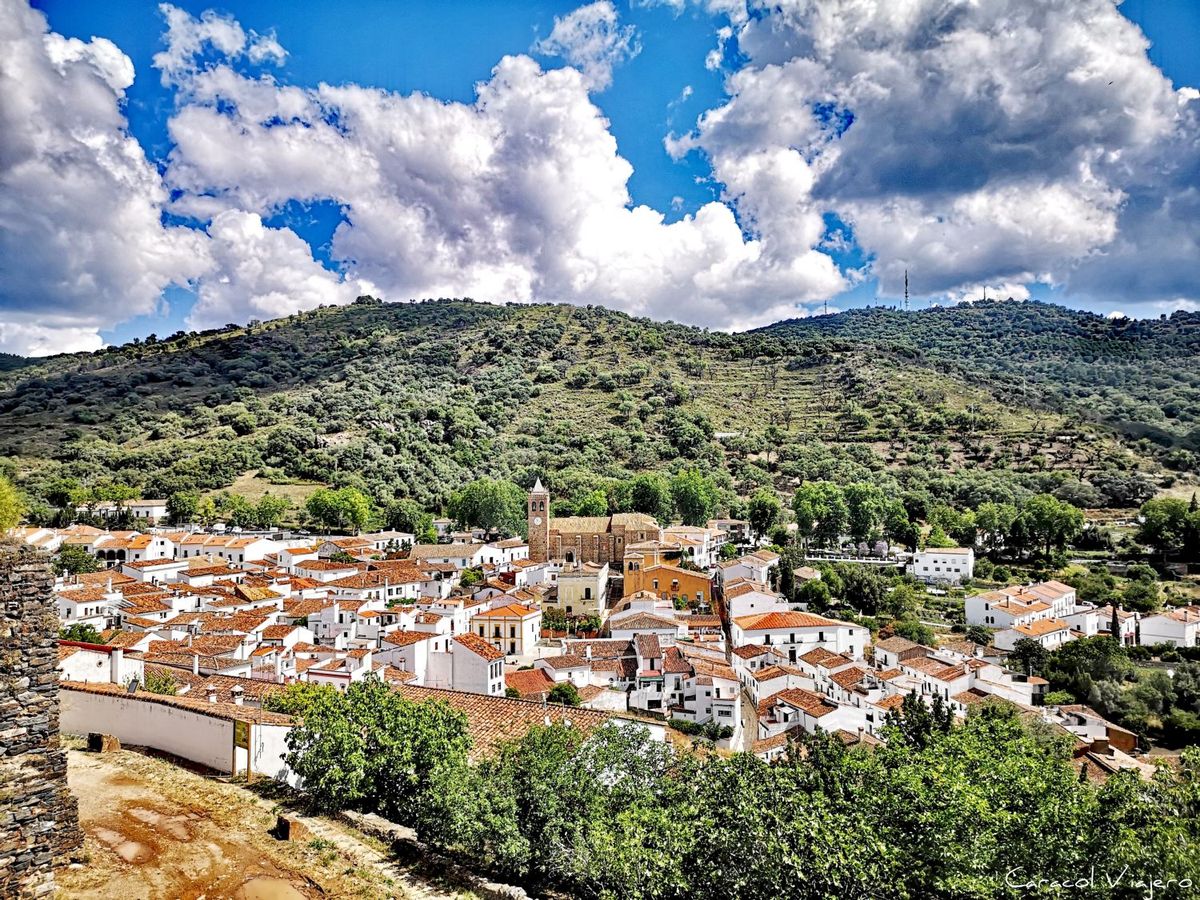
Sierra de Aracena is in the north of Huelva, inside the Parque Natural Sierra de Aracena y Picos de Aroche — 186,827 hectares, 28 municipalities, around 41,000 inhabitants per the Junta de Andalucía. Aracena, the capital, holds about 8,000 people and the Gruta de las Maravillas, the most-visited natural monument in Huelva and the most extensive show cave open to the public in Spain. Around it sit Alájar under the Peña de Arias Montano, Almonaster la Real with its tenth-century mosque, Linares de la Sierra where the plaza doubles as the bullring, Fuenteheridos, Galaroza, Cortegana, Aroche.
Sierra de Gata is in the far north-west of Cáceres, on the Portuguese border — 20 municipalities, around 22,000 inhabitants, half the population of Aracena across a smaller, more emptied-out map. I cover it in full in the Sierra de Gata deep-dive; read that first if Gata is the one pulling at you. The short version: cheaper, quieter, more purely Spanish, and carrying a wildfire history Aracena does not.
The confusion is understandable and worth clearing up now: these are not two versions of the same house. They are two different bets on how discovered, how connected, and how expensive you want your corner of green Spain to be.
Which one is cheaper to buy in?
Sierra de Gata, and it is not close.
Gata's floor sits near €120/m² for unrestored village stock; a habitable village house runs €40,000–€80,000, and a renovated stone house with a garden tops out around €120,000–€250,000. The reason is structural: Extremadura is one of Spain's least foreign-bought regions, at roughly 2–4% foreign buyers against about 13% nationally per the Colegio de Registradores, so prices were never bid up.
Sierra de Aracena costs more. Huelva province averaged around €1,700/m² in mid-2026, and while the rural sierra sits well below that provincial figure, it sits clearly above Gata. Habitable village houses in the comarca cluster around €60,000–€150,000, renovated stone houses with land run €150,000–€350,000, and the cheapest unrestored shells start near €15,000. [UNVERIFIED — confirm the current Sierra de Aracena €/m² and these ranges against the latest monthly Idealista informe for Huelva rural before publish.]
The premium is not random. Huelva runs about 9–12% foreign buyers — three to four times Extremadura's share — because Aracena has been bought into for forty years and sits inside a weekend market from Seville. You pay more here because other people already decided it was worth it. That is the whole trade, stated as a price.
Which sierra is easier to reach — the airport question?
This is the line item nobody puts in the spreadsheet, and it may settle the whole decision.
Aracena is about 90 kilometres from Seville, a little over an hour by car on the A-66 and N-433, which means Seville airport is under an hour and a quarter from your front door. Seville is a major international airport with direct flights across Europe and seasonal transatlantic connections. You can land at midday and be eating in Alájar by two.
Sierra de Gata has no equivalent. The nearest airport is regional Salamanca-Matacán; a major international hub — Madrid, Lisbon, Porto, Seville — is two and a half to four hours away by road. Madrid alone is roughly three hours.
For a second-home owner who flies in six or eight times a year, that gap compounds into days of your life annually and a real difference in who will come to visit. On access, Aracena wins decisively. If you fly more than you drive, this one factor may be enough to end the comparison here.
Will you find a community already there?
Aracena, yes. Gata, not really — and for some buyers that is precisely the point.
Northern Europeans and Britons have been buying and restoring houses across the Sierra de Aracena since the 1980s, reopening village bars and restarting traditions along the way. By now there is barely a village in the comarca without a foreign resident or two, which means an Anglophone layer you can plug into on day one: someone who knows a builder, a gestor, which notary is quicker. You arrive into a scene.
Sierra de Gata has no such layer. Extremadura's 2–4% foreign share means you will likely be the only foreigner in your village, or close to it. The texture stays more purely Spanish — including A Fala, the Galician-Portuguese micro-language still spoken in three of its villages. Whether that reads as isolation or as the entire reason to go is the most personal question in this comparison.
Verdict: Aracena for the buyer who wants a community waiting; Gata for the buyer who wants to be early. Be honest with yourself about which one you are before you book a flight, because it does not change after you sign.
Which has the better climate, and which carries more risk?
Both are "green" for the same reason — Atlantic and mountain influence that keeps chestnut, cork oak and dehesa alive where the rest of the south burns brown. The difference is what kind of weather, and what kind of risk, you are signing up for.
Sierra de Aracena is one of the wettest corners of southern Spain, with well over 1,000 litres per square metre a year, most of it falling across roughly sixty winter days. That buys you a cool, walkable summer when Seville is at 40°C, and it costs you grey, damp winters and the maintenance a wet climate demands of an old stone house. Fire exposure is comparatively low.
Sierra de Gata is drier and more continental, with brighter shoulder seasons and Starlight-certified dark skies — and a real, recent wildfire narrative. The 2015 fire burned around 7,800 hectares; August 2025 was Spain's worst season since 1994, with Cáceres among the hardest-hit provinces. Gata is managing it seriously through the Mosaico Extremadura mitigation programme, and the risk is livable, but it is real and it is priced into the quiet.
So the honest framing is a swap: Aracena trades wetter winters for lower fire risk; Gata trades fire risk for drier, brighter, darker-skied seasons. If I had to carry one of those risks, I would rather clear gutters than firebreaks — Aracena, on this axis, for me.
Jamón or A Fala: what each place is actually about
Every region has an identity; these two happen to have unusually strong and unusually different ones, and the difference tells you what daily life feels like.
Aracena's identity is the black pig and the oak forest it feeds under. This is DOP Jabugo country: 100% Iberian acorn-fed hams, cured for more than three years in secaderos across Jabugo, Cortegana, Cumbres Mayores and Galaroza, drawing on the montanera — the autumn acorn season out on the dehesa. It is a globally recognised product, a year-round economy, and a reason strangers already know the name of your comarca. You can taste it, sell it, build a Saturday around it.
Gata's identity is quieter and rarer. It is A Fala, the micro-language of Eljas, San Martín de Trevejo and Valverde del Fresno, and it is the dark sky that earned the comarca its Starlight certification in 2026. One is a product; the other is a texture you live inside rather than trade. Neither wins this outright — but know which kind of identity you actually want to wake up in.
Can you let it out? Two regions, two rulebooks
If part of the plan is short-let income, the two sierras sit under different regimes, and Aracena is the easier bet on both demand and clarity.
Aracena falls under Andalucía's tourist-housing rules, reshaped by Decreto 31/2024, which renamed the old VFT to VUT (vivienda de uso turístico), added a mandatory declaración responsable de compatibilidad urbanística, fixed a declared operating period, and let a community of owners block the activity in its statutes. The tourism demand behind it is strong and reasonably year-round — Seville day-trippers, jamón tourism, hiking the park.
Gata falls under Extremadura's CTR framework (Decreto 65/2015), which classifies rural lets as casas de turismo rural with minimum-equipment and inspection requirements. Demand is thinner and more seasonal. I cover the Gata mechanics in that deep-dive.
Verdict: Aracena is the better letting proposition on demand and rulebook. But be clear-eyed — neither comarca is a Costa-yield play, and if the numbers only work as a rental, you are buying in the wrong part of Spain.
The scorecard: which sierra wins on what
No single factor decides this, so here is the whole board at a glance. Aracena takes access, community, letting potential, low fire risk and food economy; Gata takes purchase price, cost of living and the undiscovered feel. Count what you actually care about, not what scores highest. The scorecard below lays out all eight factors and the winner on each.
So which one should you buy in?
Buy in Sierra de Aracena if you will fly in often, want a lettable house within an hour of an international airport, value an existing community and a food economy, and can absorb both the higher price and the wet winters. Buy in Sierra de Gata if you want the cheapest genuine option, you are willing to drive, you would rather be early than comfortable, and dark skies and quiet matter to you more than a scene.
For what it is worth, my own pick tilts to Aracena — not because it is prettier, but because the Seville airport run changes how often a second home actually gets used, and a house you reach easily is a house you use. The one honest caveat: I have spent far more time in Gata than in Aracena, so treat my verdict as a strong lean, not a settled deal, and go drive both before you commit. The version of each place that matters is the one you see on a wet Tuesday, not a bright Saturday.