
Why does the Sun's height decide where you should stand?
Because on 12 August 2026 the Sun is almost on the horizon when it goes out. The Instituto Geográfico Nacional puts it at 12 degrees above the horizon at A Coruña, 8 degrees at Burgos, and 2 degrees at Palma de Mallorca — the last of these moments before sunset. Eight degrees is about the width of your fist held at arm's length.
That one number reorganises the whole decision. At that height the Sun is not overhead where any open field will do; it is sitting in the last slice of sky above the western skyline. A line of poplars, a barn, a ridge two kilometres west — each of them takes the eclipse away from you completely.
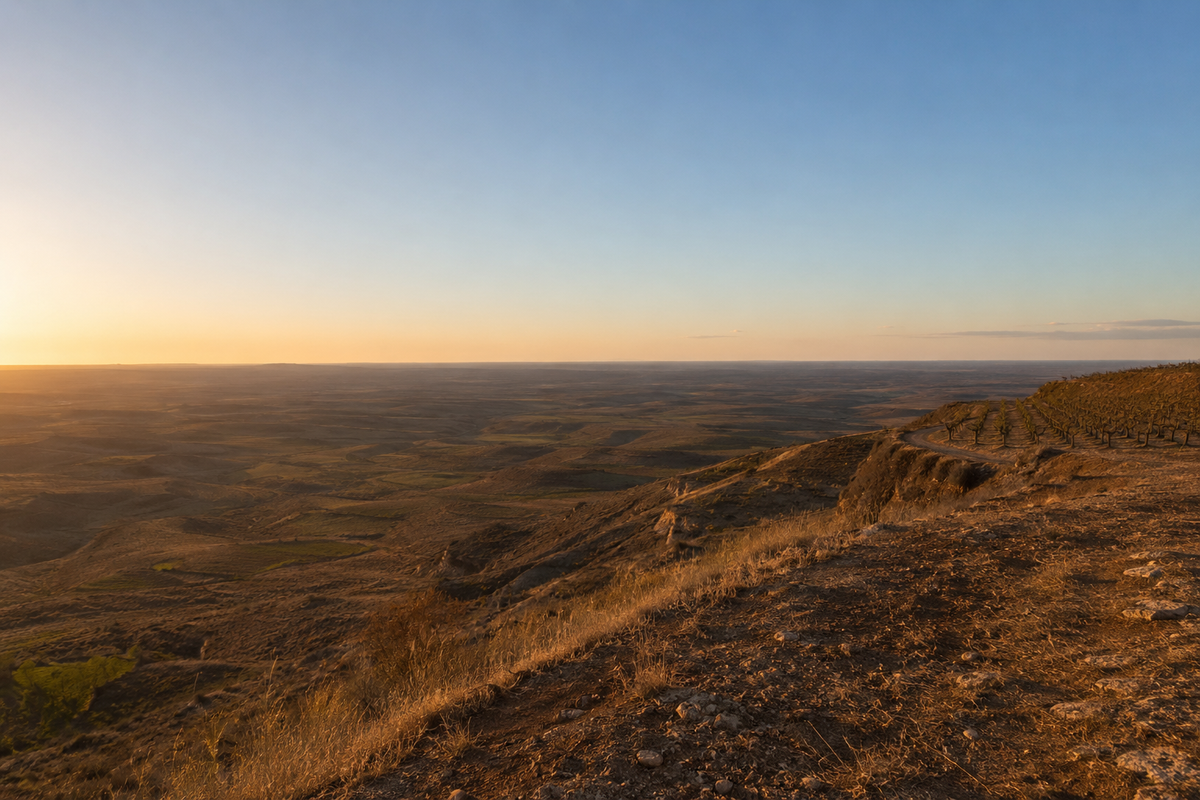
So the rule is the opposite of what the postcard suggests. You want a west-facing terrace, a hill town, a vineyard slope, the lip of a meseta. You do not want a valley floor, an east-facing hillside, or a square hemmed in by four-storey buildings. IGN's own advice is to find a spot where the western horizon is clear of hills, buildings and trees.
You can check this before you drive anywhere. The Spanish government's official eclipse channel, Trío de Eclipses, runs a horizon viewer: give it a location and it tells you whether the terrain and buildings around you will block the Sun at that altitude. I have been testing ridges in Soria against ridges in the Rioja with it, and it has already talked me out of two spots I liked the look of on a map.
One thing that is not optional. You need certified ISO 12312-2 solar filters for the whole partial phase, which runs for more than an hour either side of totality. The seconds of totality itself are the only moment the naked eye is safe, and the moment the Sun's edge returns you need the glasses back on. Trío de Eclipses carries the official eye-health guidance.
Where exactly does the band of totality cross Spain?
The band of totality is the strip where the Moon covers the Sun completely. Stand inside it and the sky goes dark. Stand a few kilometres outside it and you get a partial eclipse — a bitten-looking Sun, no darkness, none of the reason you drove there.
According to IGN, that strip crosses the peninsula from A Coruña in the northwest to Palma de Mallorca in the southeast. Inside it: Lugo, Oviedo, León, Zamora, Valladolid, Palencia, Segovia, Burgos, Soria, Santander, Bilbao, Vitoria-Gasteiz, Logroño, Guadalajara, Cuenca, Zaragoza, Teruel, Lleida, Tarragona, València and Castelló de la Plana.
Inside the band runs the centerline, where totality lasts longest — IGN puts it close to Avilés, Oviedo, Aranda de Duero, Soria, Peñíscola and Palma. The longest totality anywhere on 12 August is 2 minutes 18 seconds, and that falls near Iceland, over water. In the Spanish interior you get between roughly 75 and 110 seconds.
One line for anyone flying in: Madrid is outside the band. The capital sees a partial eclipse only. If you land at Barajas you have a two-to-three hour drive north or east ahead of you, and you should build it into the plan rather than discover it on the day.
Which rural bases are best for the 2026 eclipse?
Seven places, ranked by what I would do with my own evening. Times are peninsular official time, the same clock the Balearics use. Altitudes are the Sun's height above the horizon at totality.
One note on precision. IGN publishes exact circumstances for every Spanish municipality, but only through an interactive tool, and two reputable Spanish sources disagree on the second-by-second durations for several of these towns. So below I give the totality window and the Sun's altitude, which every source agrees on, and leave the exact duration out where it is contested. Everything in this band runs a little over or under a minute and a half.
1. The Soria high plains
Totality around 20:29–20:31, Sun at 7 degrees. Near the centerline, thin on people, and some of the clearest air in interior Spain. The catch is that Soria sits inside the Sistema Ibérico, which IGN flags for afternoon cloud build-up in August — so take the open high plains and the meseta lip rather than a wooded summit. My first pick, with that caveat attached.
2. La Rioja Alta
Totality around 20:28–20:31, Sun at 7 degrees. The vineyard country west of Logroño gives you exactly the geometry you need: terraces that face west by design, with long open sightlines down the Ebro. It is also one of the few areas with beds still free at the time of writing. This is a La Otra Vida region, and it is the one I will be standing in.
3. Ribera del Duero, around Aranda de Duero
On the centerline, on open meseta, with the longest totality on this list and horizons that go on for twenty kilometres. If you are optimising purely for the odds of seeing the thing rather than for where you want to wake up, this is the pick.
4. The Maestrazgo, inland Teruel and Castellón
Teruel around 20:30–20:33 at 5 degrees, Castelló de la Plana around 20:31–20:33 at 4 degrees. High, dry, close to the centerline point at Peñíscola, and the other La Otra Vida region in the path. At 4 or 5 degrees the horizon requirement stops being advice and becomes the entire plan — a single hill in the wrong place ends your evening. Same Sistema Ibérico cloud caveat as Soria.
5. The interior Aragón steppe
Zaragoza around 20:29–20:30, Sun at 6 degrees, and the empty country south and east of it better still. The Ebro valley carries some of the best August cloud odds in the whole band, and the steppe between Zaragoza, Belchite and Teruel offers the flattest western horizons in Spain outside the meseta.
6. Rural interior Asturias
Totality around 20:27–20:30, Sun at 10 degrees — the highest Sun and among the longest totality of anywhere on this list, on the centerline, in genuinely beautiful country. And the worst sky odds in the band. The Oviedo–Gijón–Avilés triangle has also been fully booked since the spring. I have put it sixth, not first, and the next section explains why.
7. Interior Mallorca
Totality around 20:31–20:33, Sun at 2 degrees. The eclipse happens at the instant of sunset. You need the sea or the open plain of Es Pla to your west and nothing else — from the wrong side of the Serra de Tramuntana you will watch the sky dim and never see the Sun at all.
Are the skies clearer on the coast or in the interior?
The interior, and it is not close. AEMET ran a study specifically for eclipse day, and the numbers are blunt: the north coast of Galicia, Asturias, Cantabria and the Basque Country has clear skies only 30 to 50 per cent of the time in the eclipse window. The interior meseta and the Ebro valley run 50 to 70 per cent. The south of Spain has the best odds in the country and is outside the band entirely.
The method is what makes those figures worth anything. AEMET used sixteen years of data, 2010 to 2025, taking ERA5 reanalysis and correcting it against satellite cloud observations, sampled across 11–13 August between 17:00 and 20:00 UTC. This is not a forecast for a Wednesday evening three weeks out. It is the shape of a normal August evening in each place, repeated sixteen times.
Then the complication, which IGN raises itself and a tidier guide would leave out. The Cordillera Cantábrica, the Sistema Ibérico and the Sistema Central all build convective cloud on August afternoons through orography — air rises over high ground and makes its own weather. Soria and the Maestrazgo sit in the Sistema Ibérico. So "go inland and get high" is half right and half a trap.
The sharper version: go inland, then take open ground with a long western sightline over a mountain ridge. The meseta lip, the Ebro floor, the steppe. You need elevation relative to your western horizon, not altitude for its own sake.
IGN adds its own caveat, and I will repeat it because it is the honest frame for everything above: this is reference statistics, not a prediction. Check AEMET's short-range forecast in the days before, and be willing to drive ninety minutes on the morning of the 12th. The people who saw the 2024 eclipse in North America were, overwhelmingly, the people who moved.
Can you still find somewhere to stay?
Yes — and this surprised me. The story in the Spanish press since spring has been scarcity, and for the obvious places it is true. Hosteltur, working from SiteMinder booking data, reports Asturias hotel prices up 85 per cent and reservations up 76 per cent, with the average booking window stretching from 121 days to 215. A Coruña reservations are up 65 per cent, prices up 41 per cent. In February, elDiario.es reported rural houses that normally go for €80 a night asking €150 and up, a few above €1,000, and total occupancy across Guadalajara towns like Sigüenza and Brihuega.
But reporting from 25 July, a fortnight out, found beds still available — and found them in the interior: Aragón, Castilla y León, Castilla-La Mancha, Navarra, La Rioja and the Balearics. Named properties with rooms included a hospedería in high Teruel and a spa hotel in La Rioja. Both sit in regions on this list.
Which is the same story as the weather, told twice. The crowd went to the coast and the capitals, and the coast and the capitals are the worse bet on cloud odds and on price. What is left open is the interior, and the interior was always the better place to stand.
Two caveats and I will stop selling it. Availability at this range moves daily, so treat any list of open hotels as a starting point, not a promise. And you do not need a bed at all — the most reliable move now is to sleep somewhere ordinary an hour or two away, drive to a west-facing ridge on the afternoon of the 12th, and drive back after dark.
Why does an eclipse belong on a rural property site?
Because the map of the band of totality and the map of the Spain this site covers are close to the same map. Soria, La Rioja Alta, the Maestrazgo, the Ribera del Duero, interior Aragón — thin, high, emptying places where a village house still costs less than a car, and for one evening in August the best seats in Europe.
I find the demand spike clarifying. For a single day the market prices these regions at what a scarce, beautiful, hard-to-reach place is worth. On 13 August the prices drop back and the villages stay exactly as good as they were. That gap, between what a place is worth and what it costs, is the whole reason this site exists.
What if you miss it — when is Spain's next eclipse?
Spain gets three eclipses in twenty-nine months, and 2026 is the hard one.
The 12 August 2026 total eclipse is, in IGN's own words, the first total solar eclipse visible from the Iberian peninsula in over a century. It is also ninety-odd seconds long, eight degrees up, at sunset, in the one part of the country that clouds over in August. Every difficult thing about it is in that sentence.
Then comes 2 August 2027, easier in every dimension. IGN puts the band over Ceuta and Melilla, almost all of Cádiz province, much of Málaga province, and the southernmost edges of Granada and Almería. Ceuta gets 4 minutes 48 seconds; Cádiz gets 2 minutes 54. It happens mid-morning, around 10:45 to 10:50, with the Sun at 41 or 42 degrees — high, clear of every ridge and rooftop, in the part of Spain with the best clear-sky odds in the country. The Balearics see a partial only in 2027, despite sitting in the path in 2026. After that, an annular eclipse on 26 January 2028.
So if you cloud out on the 12th, or cannot get north in time, the south gets four times as much darkness twelve months later at a civilised hour. That is a better eclipse. It is still the second-best story, because 2026 is the one nobody alive here has seen.