
How should you think about €300,000 in the rural Spanish market?
I do most of my work between Cáceres and Lleida, so I get the same question on viewing trips and on phone calls from Brooklyn and Hamburg almost every week. Is €300,000 still enough to buy something good in rural Spain? The honest answer is that the question has stopped being national and become regional.
In April 2026, Idealista's national median for used housing reached €2,748/m². The same monthly informe puts Extremadura at €1,052/m² and the Balearic Islands at €5,236/m², a 5x spread. [UNVERIFIED — confirm against the most recent monthly Idealista informe within 30 days of publish.] That 5x spread is what makes any single sentence about "rural Spain" useless. €300,000 buys a 285m² renovated stone house with a garden in Sierra de Gata, a 109m² used apartment near the national average, and a 57m² ground-floor flat in the cheaper bits of Mallorca. The number on the price tag is identical; the asset is not the same asset.
The other tension worth surfacing in the first paragraph: this threshold is moving. The Spanish used-housing market closed Q1 2026 at €2,709/m², up 17.2% year-on-year — the steepest annual rise since the pre-2008 cycle. Inland towns that used to be the safety valve — Villena (Alicante), Torre-Pacheco (Murcia), Elda (Alicante), Villafranca de los Barros (Badajoz) — have appreciated +100% or more in three years according to the analysis Spanienpress quoted in April. €300,000 in 2026 is not what €300,000 was in 2022. The post you are reading is dated and will need a refresh; the underlying ranking is more stable than the absolute numbers.
For this guide I split the rural Spanish market into four budget bands and walk through twelve regions in order of €/m², cheapest to most expensive. I add the hidden costs by autonomous community because the spread is large enough to change the answer to which region should I buy in. I give you the math on turnkey-versus-renovation, the math on non-resident mortgages, and at the end the regions I would actually look at if I had €300,000 to spend this month. There is also one listing I walked away from. You will recognise it from the photographs.
The four budget bands the rural market actually operates in look like this:
- Under €150,000 — the renovate-or-walk tier. A village shell in Extremadura, Castilla-La Mancha or Galicia interior. Roof open in places, no kitchen, no bathroom. Habitable with €60k-€150k of work and a year. Magnificent if you have the time and the aparejador; ruinous if you do not.
- €150,000 to €350,000 — the turnkey-mid tier. Habitable village houses across most of inland Spain. Renovated to two-bedroom liveable in the cheapest regions, full restored stone houses in the cheaper comarcas of Extremadura and Castilla y León, mid-range apartments in coastal smaller towns. €300,000 sits at the upper-middle of this band and is the threshold where the question stops being can I afford it and becomes which region.
- €350,000 to €750,000 — the architect-restored tier. Serious restored masías, cortijos, caseríos with land. Architect-led work. The Premio FAD short-list lives in this band. Empordà proper and Mallorca rural now start here, not at €300k.
- €750,000 and up — prime rural. Mallorca interior fincas, Empordà coastal, Marbella hinterland. Different game; different post.
The line between bands moves with the market. The €350,000 line that separates middle from architect-restored has shifted ~€50,000 upward in the last 18 months, faster in tourism-exposed regions than inland. Read the bands as relative position, not as hard prices, and re-check the latest Idealista informe before the offer.
What does €300,000 buy before you account for fees?
The cleanest way to feel the regional spread is to convert €300,000 into square metres at the regional median €/m². It is not a perfect proxy — rural sub-markets within a community can run 30-50% below the regional average, especially in Extremadura, Castilla y León and Galicia — but it sizes the asymmetry. The April 2026 Idealista numbers give the headline:
- At Extremadura's €1,052/m², €300,000 buys roughly 285m² of used housing. In village terms: a fully-renovated four-bedroom stone house with a garden in a cabecera with services. Sierra de Gata, Sierra de Montánchez, the better villages in the Valle del Jerte.
- At Spain's national median of €2,748/m², €300,000 buys roughly 109m². A modest three-bedroom apartment in a provincial capital, or a renovated village house in a tier-two region.
- At Baleares's €5,236/m², €300,000 buys roughly 57m². A small ground-floor flat, often on a non-prime street, well outside the historic centres.
The disparity is real and it is structural. Extremadura's foreign-buyer share sat at low single digits in Q1 2026; the Balearic Islands ran at 28.89% foreign buyers, the highest concentration in Spain after Málaga province at 34.3% and Alicante province at 44.65% (Colegio de Registradores, Q1 2026 ERI). Where international buyers have been bidding for a decade, prices have moved. Where they have not, prices have not. That is the entire thesis of this post.
A practical note before we walk the regions: the €/m² figure is an asking-price median, not a closing-price median. Closing prices in rural Spain in 2026 typically run 3-8% below asking in the regions with low foreign-buyer pressure, and 0-3% below asking in the tourism-exposed ones. Idealista is what the seller wants; the deal sheet is what they take.
The twelve regions, ranked: where does €300,000 go furthest?
I have ordered the twelve regions cheapest to most expensive by autonomous-community median €/m². Each section is the same five pieces: the median, what €300,000 looks like as a listing in plain language, the foreign-buyer share, the nearest international airport, and the one thing the buyer should not learn the hard way.
1. Extremadura — €1,052/m²
The cheapest autonomous community in Spain in April 2026. Inside Extremadura, the prices that matter for the relocator buyer are the rural comarcas — Sierra de Gata, Sierra de Montánchez, Valle del Jerte, La Vera, Las Hurdes, and the Badajoz dehesa around Jerez de los Caballeros. Sub-regional medians in these comarcas run 30-50% below the autonomous-community average, so the working number for a serious viewing trip is closer to €600-€900/m² for habitable village houses.
At €300,000 in rural Cáceres or rural Badajoz you can buy a 250-300m² fully renovated stone house with a garden, in a village with a primary school, an ambulatory clinic and full-fibre internet. The same money buys a cortijo on 2,000-4,000m² of land if you are willing to be 20 minutes from the nearest village. Foreign-buyer share in Extremadura was approximately 2-4% of transactions in Q1 2026 — the lowest in Spain alongside parts of Castilla y León and interior Galicia. Cáceres is on the high-speed rail line (Madrid-Lisbon direct, opened in late 2024); Madrid-Barajas remains the practical international airport, 90 minutes by AVE.
The one thing not to learn the hard way: the residential rehabilitation grants you have read about (PRA Decreto 177/2025, the Yo Re-pueblo relocation programme) are residency-locked for non-EU buyers. They require legal and permanent residence in Spain — which means the DNV or NLV before you can apply. If you are buying as a non-resident second-home buyer, you do not qualify for the headline grants.
2. Castilla-La Mancha — €1,069/m²
Statistically a hair above Extremadura, structurally very similar at the rural level — though the geography is different. The relocator buyer here lives in the Sierra de Alcaraz (south Albacete), the Serranía de Cuenca, the Sigüenza-Brihuega corridor of Guadalajara, and the cherry-blossom Sierra del Valle del Tiétar on the Ávila-Toledo edge. The Sigüenza corridor's specific virtue is that Madrid is 90 minutes by AVE and 80-110 minutes by car — half the country comes here on weekends, which makes it more livable in winter than the comarcas further south.
At €300,000 in rural Cuenca or rural Guadalajara, the listing looks similar to Extremadura — a renovated 200m² stone house with a garden — with a price premium for the Madrid proximity in the Sigüenza corridor (knock 20-30m² off the same money there). The Albacete sierras give you more land for the budget. Foreign-buyer share is low: approximately 3-5% at the autonomous-community level, even lower in the rural comarcas.
The one thing not to learn the hard way: winters in the high villages of Cuenca and the Sierra de Alcaraz are colder and snowier than the marketing photographs suggest. Heating costs and the choice of fuel system change the renovation budget materially. Budget an extra €8,000-€12,000 for heating beyond the headline reform number.
3. Castilla y León — €1,307/m²
Spain's largest autonomous community by area, third-cheapest by median €/m². The rural sub-regions split into three families: the Sierra de Gredos (south Ávila) and Sierra de Francia (south Salamanca), warmer and closer to Madrid; Sanabria (Zamora) and the Burgos rural comarcas, colder and quieter; and the Soria province as a whole, which has Spain's lowest population density and a regional government openly courting relocators.
At €300,000 in rural Ávila or rural Salamanca, a renovated 180-220m² stone house with a small garden in a village of 200-800 residents is realistic. Sanabria is even cheaper — €300,000 here buys you a larger restored house or the same restored house plus a huerto of meaningful size. Soria province is the value play if you can tolerate the isolation: rural houses here run 20-30% below the autonomous-community average. Foreign-buyer share is low across the community, around 4-6% at the headline level.
The one thing not to learn the hard way: in the higher Sierra de Francia and Sanabria villages, the padrón (local resident register) matters more than buyers expect. Some grants and even some service-access entitlements run through the padrón; if you intend to use the house as a primary residence, register from day one and budget the time for it.
4. Galicia — €1,431/m² (approx)
The provincial spread is the widest in Spain. A Coruña province and Pontevedra province sit close to or above the national median (driven by the cities and the south Pontevedra coast); Lugo and Ourense are far below it. The rural buyer's geography in Galicia is the Ribeira Sacra (Lugo-Ourense), the Costa da Morte interior (A Coruña), Terras de Lemos and the A Mariña Lucense.
At €300,000 in rural Lugo or rural Ourense, you buy a 150-200m² stone house with a hórreo and 2,000-5,000m² of land. The Galicia premium relative to Extremadura is partly the land — most rural Galicia listings come with usable acreage — and partly the climate, which is the only Atlantic-temperate climate in Spain. Foreign-buyer share is concentrated on the coastal strips; the rural interior sits in the low single digits.
The one thing not to learn the hard way: Galician rural land registration is notoriously messy. Non-contiguous parcelas, ambiguous lindes, undocumented historical rights of way, and the montes vecinales en mano común communal-forest regime are real legal complications. Always order the nota simple, walk the boundary with a local abogado who knows Galician rural title work, and budget six to twelve months for any subdivision or boundary correction. Do not skip the title-insurance question.
5. Asturias — €1,488/m² (approx)
A small autonomous community with a sharp coast-versus-interior split. The relocator buyer's Asturias is the pre-Picos villages (eastern Asturias), the Cangas del Narcea-Tineo corridor in western Asturias, and the villas históricas like Llanes inland of the coast.
At €300,000 you buy a 180-220m² stone house in a hamlet of 10-60 residents, typically with a hórreo, often with a small manzanar (apple orchard) for cider. Western Asturias gives you more for the money than the eastern Picos villages, where pre-Picos tourism has begun to bid up renovated stock. Foreign-buyer share is concentrated on the coast (Llanes, Ribadesella); interior is in the low single digits.
The one thing not to learn the hard way: Asturias has more rain than the marketing acknowledges. Annual averages run 1,000-1,500mm in the interior valleys, double or triple the Castilla y León figures. This matters for ventilation systems, for the roofing budget, and for the seasonal-affective question every relocator faces in their second February.
6. Aragón rural — €1,576/m² (approx)
The autonomous community as a whole is mid-table because Zaragoza skews the average; the rural Aragón that matters to this audience runs 40-60% below the community median. The three sub-regions are the Maestrazgo (Teruel), the Matarraña / Matarranya (Teruel-Tarragona border), and the Sobrarbe and Ribagorza in the Pyrenees foothills.
At €300,000 you have real architectural options. In Matarraña, where the vermut generation discovered Calaceite and Valderrobres in the 2010s, prices have moved and €300,000 buys a renovated village house with a terrace or a fixer with land. Maestrazgo proper — Cantavieja, Mirambel, the high-Teruel villages — is significantly cheaper; €300,000 here buys a serious project, a 250-350m² casona with land. Sobrarbe sits between the two on price.
The one thing not to learn the hard way: Teruel is the coldest provincial capital in Spain in winter, and the Maestrazgo villages above 1,000m sit empty December through February. If you need year-round livability with a year-round neighbour, choose Matarraña or low-Maestrazgo over high-Maestrazgo.
7. La Rioja Alta — €1,683/m² (approx)
A small community, structurally homogeneous around the wine economy. The relocator buyer's Rioja is the Haro hinterland, the Najerilla valley, and the Cameros sierra to the south. The wine-tourism premium is rising — Haro proper is no longer a €300,000 region for habitable village stock — but the surrounding villages remain accessible.
At €300,000 in a Najerilla or Cameros village you buy a renovated 150-180m² village house, often with a small bodega (cellar — vinification rights vary). Bilbao is 90 minutes by road; Vitoria 50 minutes. Foreign-buyer share is moderate (5-8%) and rising. The Rioja Alavesa side (technically País Vasco, not La Rioja) gives you the lowest ITP in Spain at 4%, which is worth considering if your candidate villages straddle the line.
The one thing not to learn the hard way: the bodega attached to many older village houses comes with vinification rights only sometimes. If you want to make wine — even at family scale — verify the rights with the Consejo Regulador DOC Rioja and the village ayuntamiento before the offer.
8. Murcia interior — €1,712/m² (approx)
The province's median is dragged up by the coast; the rural interior — Sierra de Espuña, Noroeste de Murcia (Caravaca de la Cruz, Moratalla), the Altiplano (Yecla, Jumilla) — runs 30-45% below the community median. The Caravaca-Moratalla corridor is the value play of southern Spain right now: similar climate to inland Andalucía, much cheaper, and the demographic pressure that moved Torre-Pacheco prices +114% has not yet reached the Sierra de Espuña interior.
At €300,000 in rural Murcia you buy a substantial restored village house with land — 200-280m² of house, 1,000-3,000m² of land. Murcia airport (Corvera) is 45-90 minutes from these villages; Alicante 90 minutes; Almería 2 hours. Foreign-buyer share is concentrated coastal; the interior comarcas sit in the low single digits.
The one thing not to learn the hard way: water rights and irrigation infrastructure in southern Murcia are an active regional crisis. Any rural land purchase needs an explicit conversation about concesión de agua and the relevant Comunidad de Regantes. The headline "drought-resistant garden" advice does not substitute for the legal water question.
9. Comunidad Valenciana inland — €1,824/m² (approx)
The third-most foreign-bought autonomous community — 28.16% in Q1 2026 — but the data is concentrated in Alicante province (44.65%) and on the coast. Inland Castellón and inland Valencia tell a different story. The relocator buyer here lives in the Maestrazgo Castellón (Morella, Vilafranca, Forcall — across the provincial line from Aragón's Maestrazgo), the Vall d'Albaida and Vall de Cofrents in inland Valencia, and the Marina Alta interior villages behind Dénia and Jávea.
At €300,000 in the Maestrazgo Castellón you buy a serious 200-280m² stone masía with land, often architecturally significant. Morella and Vilafranca are Pueblos Más Bonitos de España members but have not yet been bid up. In the Marina Alta interior — Llíber, Senija, Parcent, Tárbena — €300,000 buys a renovated 150-180m² village house with a terrace and a view, but the foreign-buyer pressure is real and rising; expect the figure to drift further in 2026-2027.
The one thing not to learn the hard way: the inland Valencia villages within an hour of the Costa Blanca have already been bid up by the relocation wave that hit Torre-Pacheco and Villena. Specifically check three-year price history on Idealista before you anchor on a 2024 number; the +100% three-year surge mapped in the Spanienpress feature is concentrated here.
10. Andalucía rural — €1,937/m² (approx)
The autonomous community as a whole is bid up — Málaga province sits at 34.3% foreign-buyer share — but the rural Andalucía that matters here is Sierra de Aracena (Huelva), Las Alpujarras (Granada), Sierra Norte de Sevilla, and the Sierra de Cádiz. Each runs 30-50% below the autonomous-community median.
At €300,000 in Sierra de Aracena you buy a full-restoration cortijo with land — typical Huelva proportions, 200-300m² of house and 5,000m² of dehesa or encinar. In the Alpujarras, the same money buys a village house with views in Pampaneira, Capileira or Bubión; the foreign-buyer pressure here is older (the British and Dutch wave of the 1990s) and the prices reflect it. Sierra Norte de Sevilla and Sierra de Cádiz sit between the two on price; Sierra de Cádiz has a small architecture-press following that has begun to move the market.
The one thing not to learn the hard way: the Sierra de Aracena and the Sierra Norte de Sevilla have dehesa and encinar land registers that are layered with historical grazing rights, aprovechamientos, and cabreo designations that can affect what you can build, fence, or take down. The standard nota simple does not surface these; the local abogado and a walk with the seller on the land are non-negotiable.
11. Navarra rural — €2,103/m² (approx)
Mid-table autonomous community by median, but rural Navarra runs significantly below the headline because Pamplona dominates the average. The relocator buyer's Navarra is Roncal, Salazar, and Baztan: three Pyrenean valleys with strong identity and intact village life.
At €300,000 in the rural Pyrenean valleys you buy a 150-200m² caserío with garden, often with the txoko (informal cooking-and-eating outbuilding) that defines the architecture. Baztan is the most accessible; Salazar and Roncal more remote, colder, and cheaper. Foreign-buyer share is low; the social texture is Basque-Navarrese rather than relocator-led, which is part of the appeal and part of the calibration.
The one thing not to learn the hard way: the Basque cultural and linguistic context is real. Children's schooling will be at least partly in Euskera. Adult integration depends on whether you make an honest run at the language and the txoko / cuadrilla social structure. Plan for it; do not assume you will be absorbed without it.
12. Cataluña interior — €2,287/m² (approx)
The autonomous community is mid-table but the famous interior comarcas — the Empordà, the Garrotxa, the Priorat, Terra Alta, Pallars Sobirà — have widely different prices. The headline shift in 2026 is that the Empordà proper is no longer a €300,000 region. Habitable village houses in the inland Empordà comarca now start near €350,000-€400,000; renovated masías with the geometry that made the region famous start above €500,000.
At €300,000 in the Empordà interior, you buy a fixer-upper masía needing structural work or a small village house without a garden. In the Garrotxa (Olot hinterland), the same money buys a renovated village house with a small terrace and the volcanic landscape views. In the Priorat, the wine-country premium has shifted prices upward but €300,000 still buys a maset or a small village house in the secondary villages. Terra Alta is the value play of Cataluña right now: similar architectural quality to the Matarraña across the provincial line, less price pressure, and underexplored by relocators.
The one thing not to learn the hard way: Cataluña's ITP is high (between 10% and 11% depending on the price band as of mid-2026, [UNVERIFIED — confirm against the Generalitat's Agència Tributària de Catalunya page before publish]). On a €300,000 purchase the ITP swing versus País Vasco is roughly €18,000-€21,000. If you are flexible on which side of the Aragón-Cataluña border you settle, the Matarraña and the Terra Alta have nearly identical architectural and culinary character; ITP is materially different.
What do hidden costs add to a €300,000 purchase by autonomous community?
The line a serious buyer needs to internalise: a €300,000 budget at the closing table is roughly €260,000-€273,000 at the asking line, once transfer tax, notary, registry, gestor, abogado and bank-valuation costs are subtracted. The total transaction cost on a used-housing purchase in Spain in 2026 runs 9-13% of the closing price, varying mostly by the autonomous community's ITP rate.
The big variable is ITP — the Impuesto de Transmisiones Patrimoniales, the used-housing transfer tax — which each autonomous community sets independently. The 2026 general rates, [UNVERIFIED — verify each rate against the autonomous community's own Hacienda or Junta page before publish, since CCAA rates move quarterly]:
- País Vasco — 4%. The cheapest used-housing ITP in Spain. On €300,000: €12,000.
- Madrid — 6%. On €300,000: €18,000.
- La Rioja — 6%. Younger-buyer and large-family bonifications available. On €300,000: €18,000.
- Canarias — 6.5% (general). On €300,000: €19,500.
- Andalucía — 7% (general). 6% bonified for properties under €150,000 destined as primary residence. On €300,000: €21,000.
- Navarra — 6% (general, with bonification regime). On €300,000: €18,000.
- Murcia — 8% (general). On €300,000: €24,000.
- Castilla y León — 8% (general; bonified rates for rural depopulation areas). On €300,000: €24,000.
- Castilla-La Mancha — 9% (general). On €300,000: €27,000.
- Extremadura — 8-11% depending on price band (progressive structure). On €300,000: approximately €24,000-€27,000.
- Aragón — 8% (general; progressive above €400,000). On €300,000: €24,000.
- Asturias — 8% (general). On €300,000: €24,000.
- Galicia — 8% (general; reduced rates for rural areas and young buyers). On €300,000: €24,000.
- Comunidad Valenciana — 10% (general). On €300,000: €30,000.
- Cataluña — 10-11% (progressive). On €300,000: approximately €30,000-€33,000.
- Baleares — 8-11.5% (progressive). On €300,000: approximately €24,000-€27,000.
On top of ITP, the standard closing-cost ladder for a €300,000 used-housing purchase runs:
- Notary — €600-€1,200 for the escritura (sliding scale by purchase price, set by national tariff).
- Registro de la Propiedad — €400-€800 for the inscription.
- Gestor — €600-€1,500 for the administrative-pipeline coordination. Most buyers use one; some absorb the function into the abogado.
- Abogado — €1,500-€3,500 for a non-resident buyer needing English-language conveyancing. Higher for complex rural titles in Galicia, Asturias, the Sierra de Aracena.
- Bank valuation (tasación) — €350-€500 if you are using a non-resident mortgage. Required by the bank, not by the law.
- Plusvalía municipal — the seller's burden by default, but the contract can shift it. Verify in the arras contract; do not assume.
A worked example. €300,000 listing in Sierra de Gata, Extremadura: ITP approximately €24,000, notary €900, registry €600, gestor €1,200, abogado €2,200, tasación €400. Total closing costs: €29,300, or 9.8% of the purchase price. The same €300,000 listing in the Garrotxa, Cataluña: ITP €30,000 at the lower end of the Cataluña band, with the rest of the ladder similar — total closing costs €35,300, or 11.8%. The Cataluña-versus-Extremadura swing on identical paperwork is about €6,000, which is roughly the difference between a usable kitchen reform and a luxury one in the same renovation budget.
The two costs that catch every first-time foreign buyer: the plusvalía if it gets pushed onto you in the contract (typically 1-3% of the price), and the complementaria — a back-assessment by the autonomous community if Hacienda decides the declared price is below the cadastral valor de referencia. Both are real; both are negotiable in the arras; neither shows up in the headline tax calculator.
Should you buy turnkey at €300,000 or buy a fixer and renovate?
The math has shifted since 2024 and the honest answer is now more region-dependent than it used to be.
Full-reform renovation in rural Spain in 2026 runs €900-€1,400/m² for a substantive remodel that includes structure, roof, electrics, plumbing, insulation, kitchen, two bathrooms and a finish that respects the casco antiguo. [UNVERIFIED — confirm against CYPE / Generadorde precios.info and at least one named aparejador quote at draft time.] Light-touch reform — paint, plumbing fixtures, kitchen-only — runs €350-€550/m². Heritage stonework, traditional encalado, piedra seca boundary walls, or vigas vistas timber restoration push the upper end of the range toward €1,800/m² and above.
The €100,000 + €200,000 path looks like this on paper. €100,000 for a village shell in Extremadura, Castilla-La Mancha or interior Galicia — 200m² is realistic. €200,000 of reform at €1,000/m² covers the structural and finish work. You end up at €300,000 all-in with a house that is materially superior to the €300,000 turnkey listing — bigger, more architecturally specific, restored to your specification.
What that ignores: time, regulatory risk, and the aparejador dependency. The renovation route takes 9-18 months from escritura to habitable. You will need a Spanish-resident aparejador (a technical architect) on retainer from before the offer; this is the role you cannot outsource. You will need a licencia de obras from the ayuntamiento, which takes 3-6 months in most rural municipalities. If the building sits in a Conjunto Histórico, add the heritage-board review, which can take another 3-6 months. PREE 5000 energy subsidies cover up to 80% of qualifying works for residents (Real Decreto framework, [UNVERIFIED — confirm against the latest BOE convocatoria at draft time]). Regional rehab grants — Extremadura PRA, Galicia Rehabilita, Castilla y León rural programmes — add more, but are residency-locked.
In the buyers I have watched do this well versus badly, the pattern that separates them is simple: the buyers who do it well have an aparejador in the room before the offer goes in, not after. The buyers who do it badly buy the shell, then look for the aparejador, then discover the structural surveys, the cédula de habitabilidad gap, the heritage-board overlay, and the gestor's bill is three months in before any actual work has happened. If you do not have the relationship, the regional fluency, and the calendar to wait, the turnkey route is the right one.
The honest read in 2026: in the cheapest regions (Extremadura, Castilla-La Mancha rural, interior Galicia, Soria), the €100k + €200k path still beats the €300k turnkey if you have the aparejador and the time. In the middle-priced regions (La Rioja, Castilla y León rural away from Madrid, Asturias interior), the two paths cross — pick on temperament and timeline rather than math. In the bid-up regions (Empordà, Mallorca rural, Sierra de Aracena, Marina Alta), the turnkey at €300k is no longer realistic and the choice becomes €500k turnkey versus €200k shell plus €350k of work. Different budget conversation.
Can a non-resident get a mortgage in Spain for €300,000 in 2026?
Yes, with the following parameters as of mid-2026, [UNVERIFIED — verify against BBVA, Sabadell, Caixabank, and ING current non-resident product pages at draft time].
Typical non-resident LTV is 60-70% of the bank-appraised value, which is usually below the asking price by 3-10%. On a €300,000 asking price with a €280,000 appraisal, that gives you €168,000-€196,000 of mortgage. You need €104,000-€132,000 cash at closing, plus the €30,000-€35,000 in transaction costs, plus a €5,000-€10,000 liquidity buffer the bank may want to see. Working figure: plan for €140,000-€170,000 of liquid cash to clear a €300,000 purchase via a non-resident mortgage.
Rate spread versus a Spanish-resident borrower is 50-100 basis points on the mixed fixed-variable products that dominate the Spanish market. The fully-fixed products (typically 15-25 year terms) sit at a higher rate but remove the Euribor risk for the expatriado who does not want a second variable in their life.
The banks to call: BBVA has the most mature non-resident product on the rural side; Sabadell is the strongest for the higher-net-worth Anglophone buyer (their expatriate desk in London and Madrid is the cleanest interface); Caixabank has the broadest regional branch network, which matters more in Galicia, Asturias, Extremadura where the nearest specialist office may be 80km away; ING is the digital-first option, useful if you bank with them already in Northern Europe. Private banking routes open up above €500,000 and are a different conversation.
Two things to know going in. First, the appraisal step is the gate. A €300,000 asking price that the bank appraises at €260,000 does not just shrink your mortgage; it tells you the asking price is structurally above the comparable closing prices the bank can see, and you can use that data in the arras negotiation. Second, the bank will require you to insure the property with their preferred aseguradora during the loan, which adds €350-€700/year to the running cost. This is bundled into the mortgage offer but counts as a closing-cost item; budget it.
Where would I actually look at €300,000 right now?
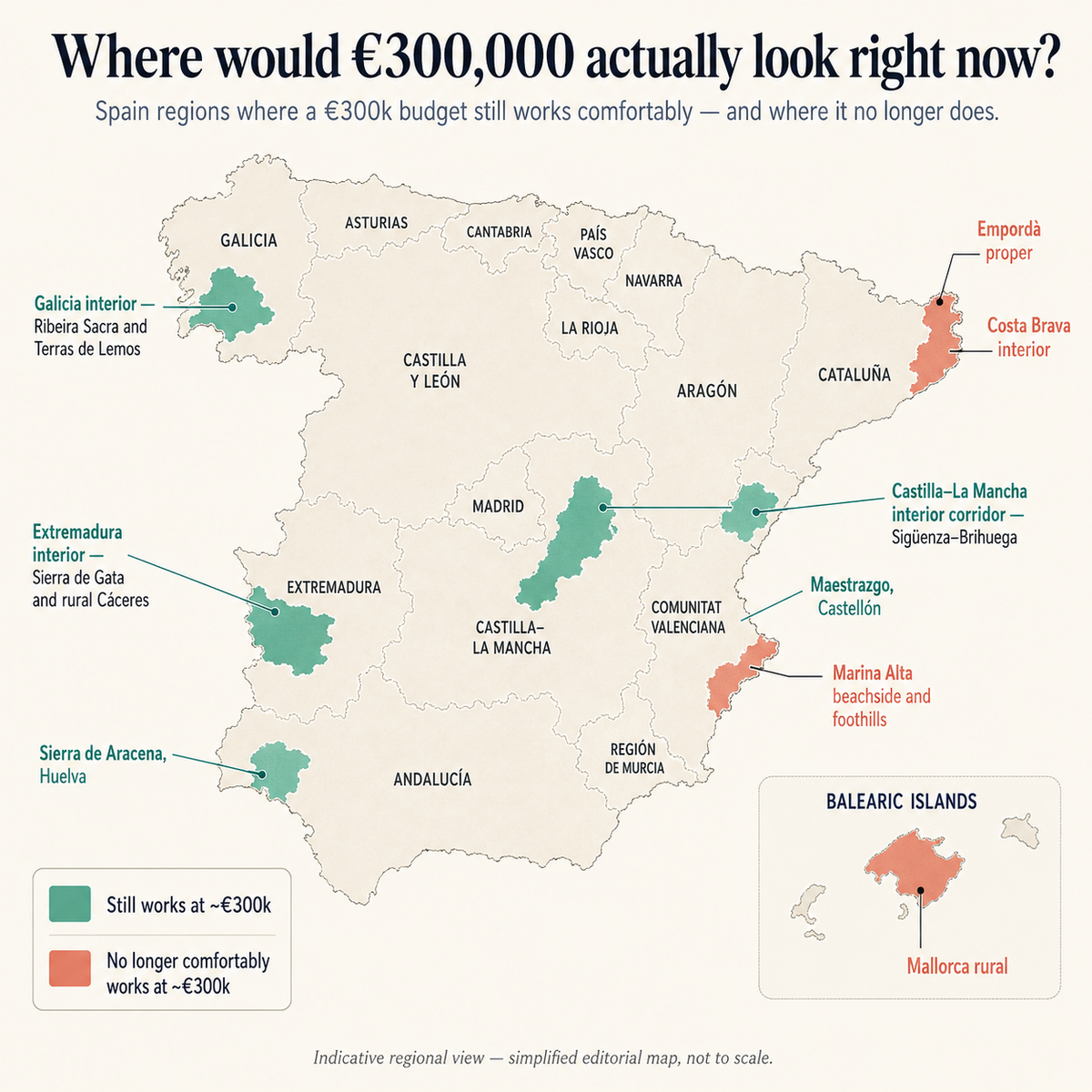
The honest verdict for a buyer asking me this question in May 2026. Five regions where €300,000 still buys a serious house with a margin of comfort:
- Sierra de Gata and the rest of rural Cáceres. The €300,000 listing in Hoyos, Gata or San Martín de Trevejo is a 250m² renovated stone house with a garden in a village with services and fibre. The Q2 2026 market is soft enough that closing prices run 4-8% below asking. (See the Week 2 region post for the deep dive.)
- The Sigüenza-Brihuega corridor of rural Guadalajara. Same architectural class as Extremadura with a 90-minute AVE link to Madrid. The Madrid weekenders bid up the most photogenic villages, so the buying angle is the second-tier villages 20 minutes off the AVE line.
- Maestrazgo Castellón — Morella, Vilafranca del Cid, Forcall. Architecturally serious masías, Pueblos Más Bonitos de España members, and prices that the Anglophone press has not yet noticed. Castellón airport is 90 minutes, Barcelona 3 hours.
- Galicia interior — Ribeira Sacra and Terras de Lemos. €300,000 buys a stone house with usable land in a comarca whose food, wine and landscape are first-class. The lindes work is the gate; with the right abogado the work is buying a generation of value.
- Sierra de Aracena. A cortijo with dehesa land for €300,000 is still on the market in 2026. The foreign-buyer pressure is older and more dispersed than Málaga; the Q1 2026 Registradores share for Huelva province sits in the single digits.
Three regions where €300,000 no longer comfortably gets a serious rural house:
- Empordà proper (Cataluña). Habitable village houses now start €350-€400k; masías start above €500k.
- Marina Alta beachside and the foothill villages within an hour of the coast (Alicante). The 44.65% foreign-buyer share in Alicante province has bid up the inland villages too. Calpe-and-out is still a Costa Blanca buy; the inland-village discount of three years ago has compressed.
- Mallorca rural outside Pollença and Sóller. The €300,000 line buys a small flat, not a finca.
The walked-away listing: a fixer-upper masía in the inland Empordà, asking €295,000 in October 2025. Three hectares of bosc and olivar. The bones were beautiful — Catalan stone vaulting in the celler, an intact original galeria. The aparejador who walked it with me put the full reform at €340,000-€380,000 including a new teulada, structural reinforcement of the south wall, and a kitchen-bathroom-electrics package that respected the original geometry. €295,000 + €360,000 = €655,000 before the heritage-board review of the south façade. Sep walked. Not because the house was wrong — it was right — but because €655,000 for a finished masía in the Empordà interior is not a buy at €655,000; it is the market clearing price. If you want that asset, the honest budget is the honest budget; do not let the listing price fool you. The €300k masía in the Empordà is the seducer; the €660k finished masía is the deal.
If you are reading this and the €300k threshold has slipped behind you — if the answer is increasingly no, this region too has moved — the right move in 2026 is to go further inland, further north, or further south away from the Mediterranean coast. Extremadura, rural Castilla y León, interior Galicia, the Maestrazgo Castellón, the rural Pyrenean valleys. These are the regions where €300,000 still does what €300,000 used to do everywhere. The longer you wait, the smaller that list becomes. The Spanienpress feature dated 2026-04-20 is the warning shot; ignore it at the cost of buying the same house for €60,000 more in 2028.